Python for Modelling and Visualising the Solar System
Python has become a favourite language for exploring the Solar System, from school projects to professional research. Its free, readable ecosystem turns complex celestial mechanics into workflows anyone can follow. The same small set of libraries covers both calculation and visualisation.
Two ways to model the planets
There are two main approaches: simulate the orbits yourself, or read positions from ephemerides. A simulation starts from known positions and velocities and steps Newton's law of gravitation forward in time. It is ideal for learning the physics and for "what if" experiments.
Ephemerides are precomputed tables of planetary positions, published by agencies such as NASA's Jet Propulsion Laboratory (JPL). They are far more accurate than a simple simulation, because they include perturbations and decades of observations. You can read more in my article on ephemerides.
Tools and libraries
NumPy and SciPy form the foundation, with fast arrays and ready-made solvers for equations of motion. Astropy handles units, time scales and coordinate frames. Skyfield and jplephem give easy access to JPL ephemeris files, REBOUND runs fast N-body simulations, and poliastro (now continued as hapsira) covers orbital mechanics.
Visualisation
Original image: 1613 x 853
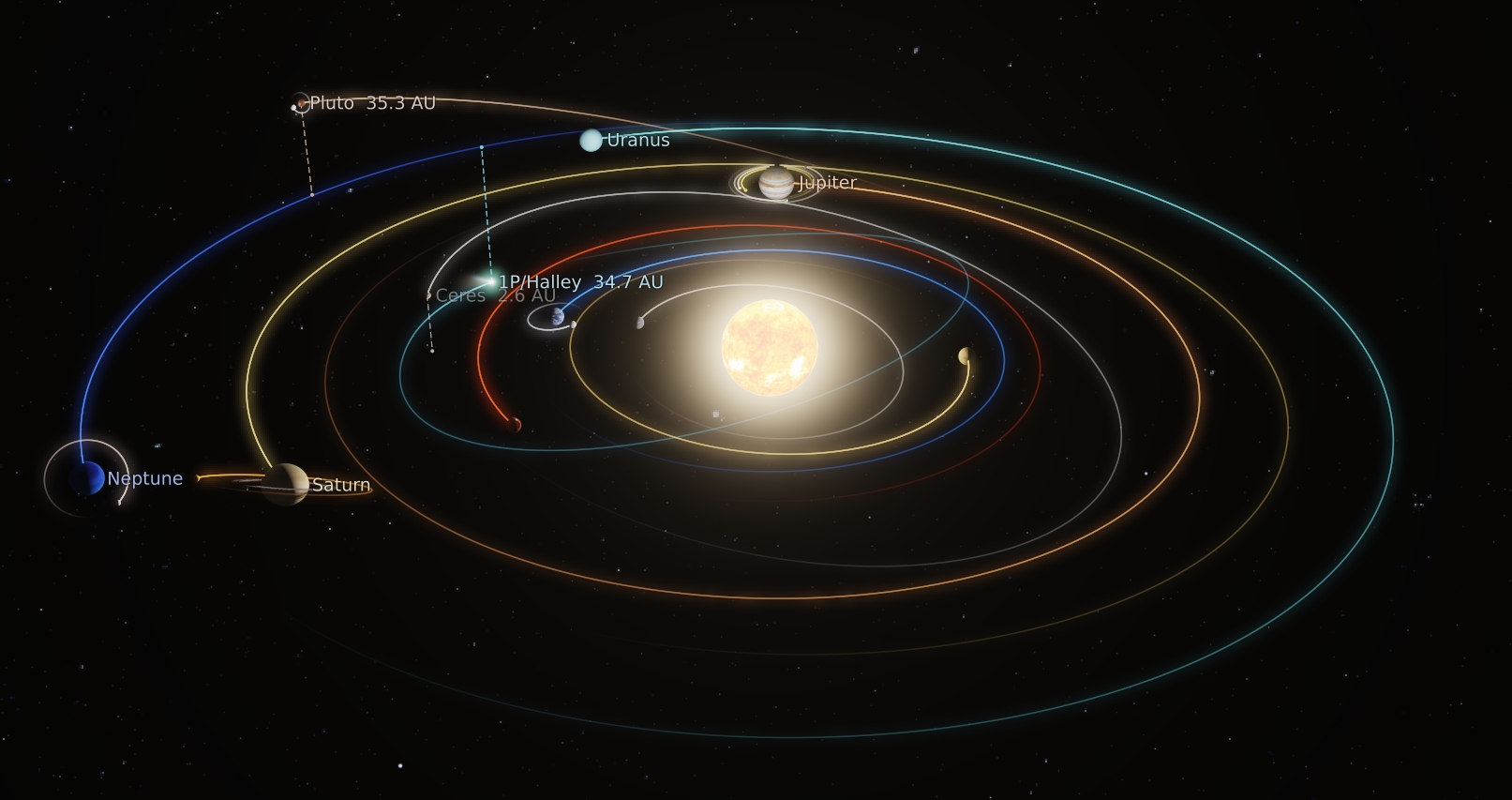
Matplotlib is the classic choice for 2D orbit plots and simple animations. Plotly adds interactive 3D scenes that can be rotated in a browser. VPython makes real-time 3D animation of planets and moons surprisingly easy.
Conclusion
Combining accurate ephemerides with Python's plotting tools lets anyone build a working model of the Solar System. It suits education, curiosity and real scientific analysis alike.Astronomy offers a fascinating playground for numerical analysis, mathematical modelling, and scientific visualisation. By combining physics with computational methods, we can simulate the motion of planets and satellites, explore gravitational fields, investigate orbital dynamics, and model the evolution of complex astronomical systems. Through numerical experiments and interactive visualisations, abstract equations become tangible, revealing the underlying mechanisms that govern the universe. From the trajectories of spacecraft to the large-scale structure of the Solar System, this section explores how scientific computing can help us understand astronomical phenomena, test physical ideas, and discover new ways to visualise the cosmos.
Published: 2026-10-16 19:07:19